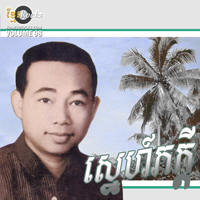
Sinn Sisamouth: History Continues
|
|
|
|
| Keo Chamnab tells us that after being evacuated from Phnom Penh and living in a village in Koh Thom district for three months, the Khmer Rouge took him "to a jail know as Center 15 which was then known as Area 25 (located next to a Vietnamese church along the river, in Village no. 1, Pau Ban commune, Koh Thom district, Kandal province)." | |
"Arriving at Center 15, I saw a camp fenced with bamboo
trees. The camp is about one kilometer long by about 150 meters wide. They
pushed me inside the bamboo fence and told me to go to a brick roof house built
on stilts. Below the house there were young security guards stationed there.
That was the Khmer Rouge’s Angkar jail. They told me to go upstairs. As soon
as I opened the door and stepped in, I saw plenty of men and women prisoners, at
least 60 of them, they were manacled and shackled in rows to long steel rods.
This made me so scared. When they put me in jail and shackled me to other
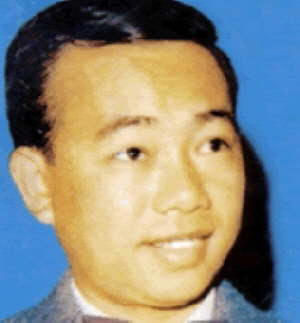
prisoners, I was very surprised to see Bong (Old Brother) Sinn Sisamouth, Kong
Sam Oeun (a famous film star), and a number of other artists who were also
jailed there."
Chamnab tells us that one time, when he was shackled
nearby, "Samouth, looking very sad, told me that he was sent from Prek Eng, Kien
Svay district, Kandal province, where he had been jailed for three days. He did
not commit any fault but he was accused by the Khmer Rouge of being an
imperialist. It was difficult for Sinn Sisamouth to hide his identity and his
face because he was a very famous singer dubbed the emperor of the country since
long ago. Even if the Khmer Rouge did not accuse him of being a singer serving
a regime which was a sworn enemy to that of the Khmer Rouge, he was also a
soldier serving the former regime."
 |
ON SALE, Up To 65% Off on Jewelry, Click To Enter |
 |
| "Furthermore, the Khmer Rouge policy was to oppose and destroy all government employees and those involved with the pre-1975 regime (Lon Nol regime). Therefore, it was difficult for him to escape or hide his identity." | ||
Keo
Chamab goes on to tell us some details about life in the prison; about the daily
rations - "a scoop of rice husk powder mixed with chopped up banana trees" - and
about how "the prisoners did not care about their life anymore, they did not
know when they will die, whether it will be tomorrow or another day."
"Bong Samouth told me that we no longer have any hope. He usually did not talk
much, he used to stare the jail ceiling while others whisper to one another to
reminisce about the good food they had before 1975, and some even laughed of
their past stories from the Lon Nol regime. As for Bong Samouth, he did not say
much."
Keo Chamab continues by telling us about the horrible interrogation methods used
in the prison. "During the questioning session, all prisoners are manacled on
both feet and shackled to the chair, they were beaten and some even had their
nails pulled out. As for Bong Samouth, he also bore torture marks on his
back." Keo Chamab described another incident when Sisamouth was hit in the head
by a young guard with a bamboo container normally used to pee into. "The guard
then lectured him and told him that he belonged to a group of people without
revolutionary conscience, to a group of imperialists without revolutionary
conscience. I saw tears rolling down his cheeks but he did not cry out loud as
others would because to do so, he would be hit even harder, and he had no choice
but to shed his tears in silence."
 |
|
| "Every day, I and all the other prisoners, including Bong Samouth, we always tried to peek outside through holes in the wall. We used to see the Chhlobs (spy soldiers) sharpen two or three knives and testing their sharpness. Around 4 o’clock, they would call some prisoners and take them out." | |
"They
would tell the prisoners that the Angkar had congratulated them (the guards) for
doing a good job in re-educating the prisoners, and that those prisoners who are
being called to go out, they always ended up returning back to their village
where they came from. At the beginning, we believed them, but later on we
noticed that the Chhlobs brought us back the clothes of those whom they took
away, sometimes the clothes would still be stained with fresh blood."
"In the jail, we were forced to perform hard labor for 5
months, then in November, I did not remember the exact day, around 5:30 PM, it
was already late when 2 to 3 Chhlobs came in with a list to call the prisoners
to be taken away [to kill] as usual. On that day, Bong Samouth’s name was
called among the names of four or five other prisoners. He did not change his
name and he was still known as Sinn Sisamouth. When his name was called, I was
very distressed. I saw that his face was very sad and was ashened. Before he
was escorted out, he hugged me but he did not leave any message for his family,
he simply said: “I am leaving before you Phoun (younger brother), may you remain
behind in peace.” I did not want to say much, I only replied to him: “Yes,
Bong.” His face was the face of a romantic person, he did not express anger nor
unhappiness."
| Sinn Sisamouth History Main | |||||
| Part 2 | Part 3 | Part 4 | Part 5 | Part 6 | |